Associations, ideas and considerations:
Since little people meet in these rooms every day who want to make the world their own in a playful way, I was primarily interested in comprehensibility and usability. To make simple, simple mechanical processes understandable in their mode of action, to reveal their beauty and still allow them to keep a "secret".
Based on these considerations, the main interest was in the "free" staircase wall, which is given a special accent by the light and its continuity from bottom to top. This wall connects two room levels: ground floor and upper floor, which I transform into two new terms in my conception: cause and effect!
As a playful mechanical principle, a hand crank on the wall on the ground floor, the large wheel in the 1st floor be set in motion. In addition to the playful "hands-on" it is primarily about a sign that shows the principle of transmission, which, in addition to its moving and playful content, ultimately shows the mechanism openly, in contrast to today's technology, which is mostly invisible behind boxes and boxes is more comprehensible.
It is also conceivable for this variant that the hand crank is replaced by a bicycle-like chair (see sketches) on which a child sits and kicks, thereby setting the wheel in motion. Of course, the color design can be modified.
Material: metal/polyurethane
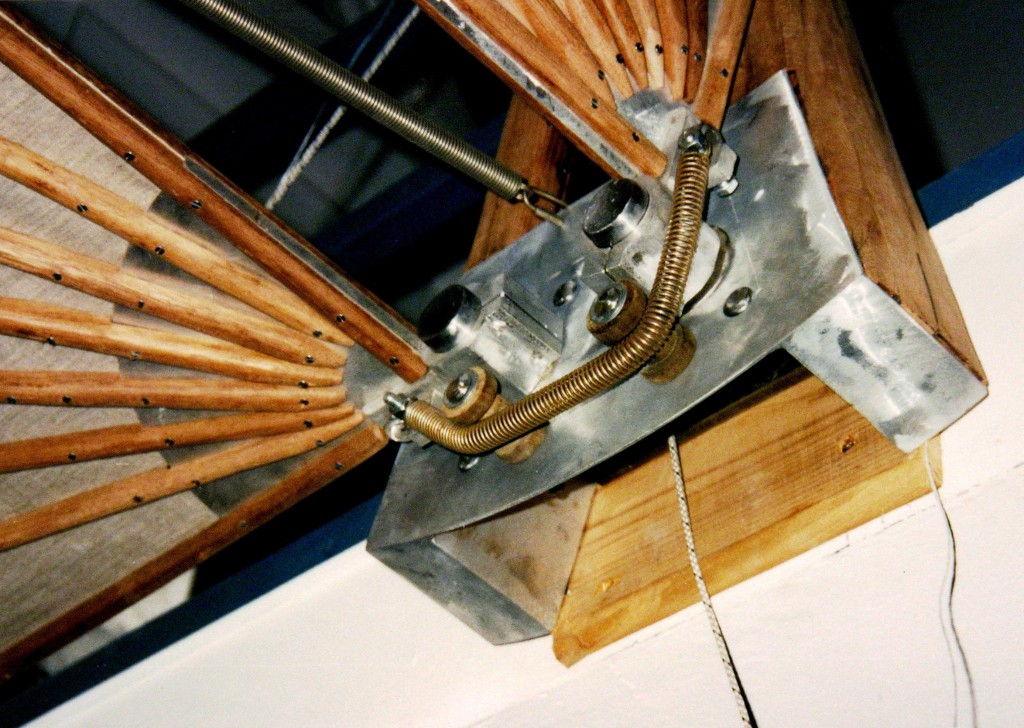 WORK IN PROGRESS, wood, metal, cloth, manual kinetic, 1997
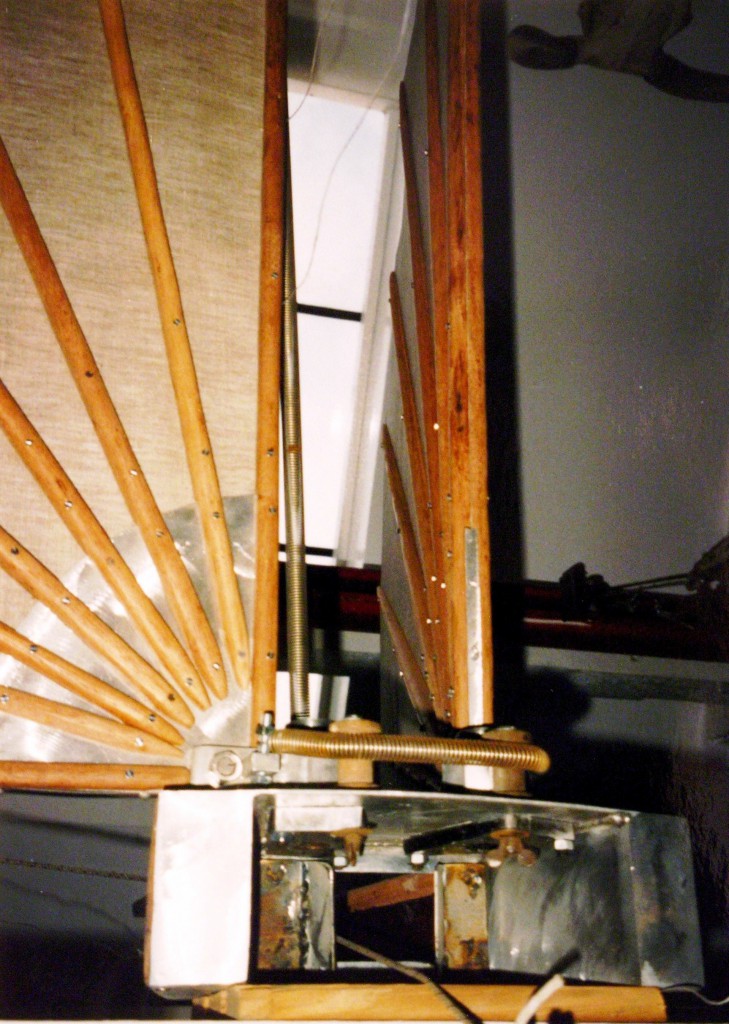 WORK IN PROGRESS, Holz, Metall, Tuch, manuell Kinetisch, 1994
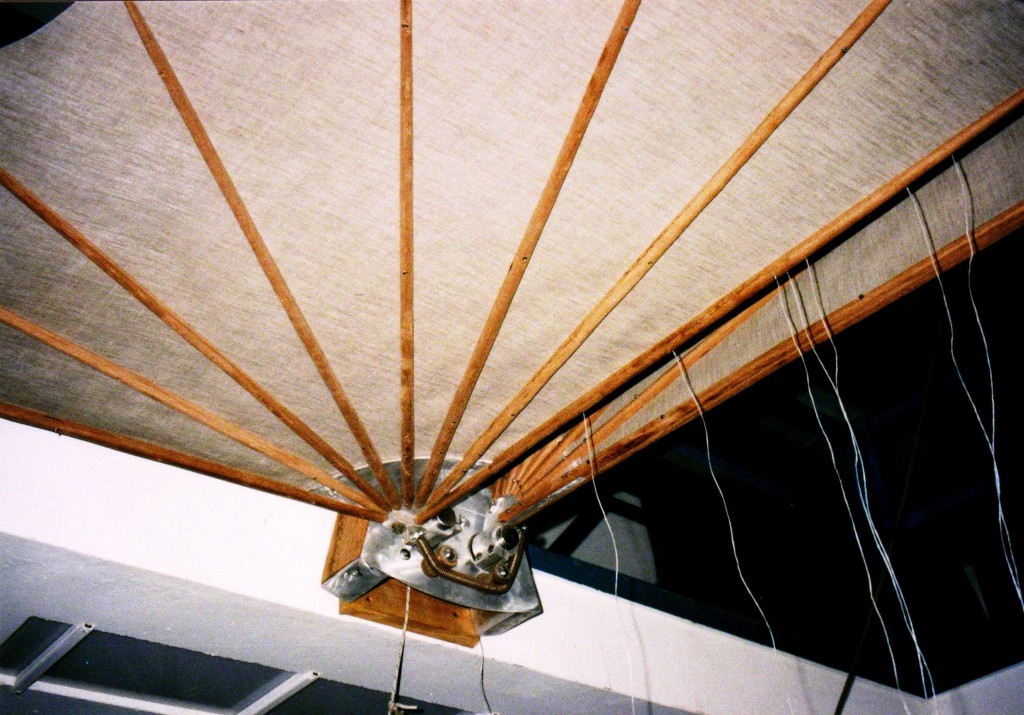 WORK IN PROGRESS, Holz, Metall, Tuch, manuell Kinetisch, 1994
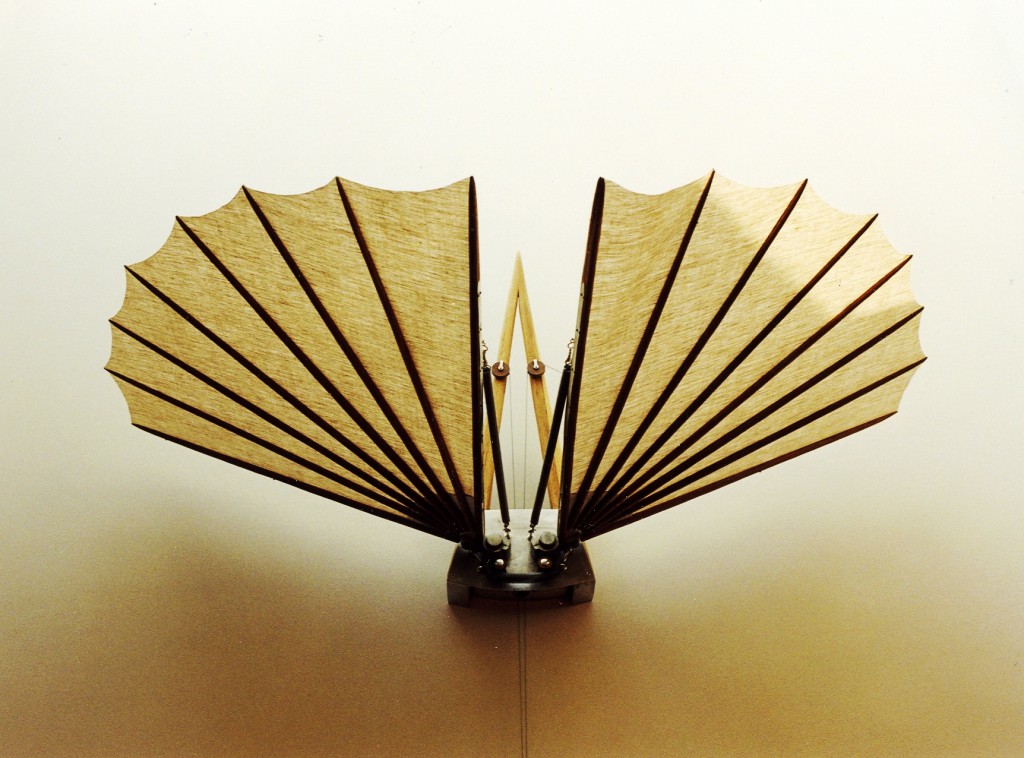 View BUTTERFLY, RAS 5, Britz, 1997
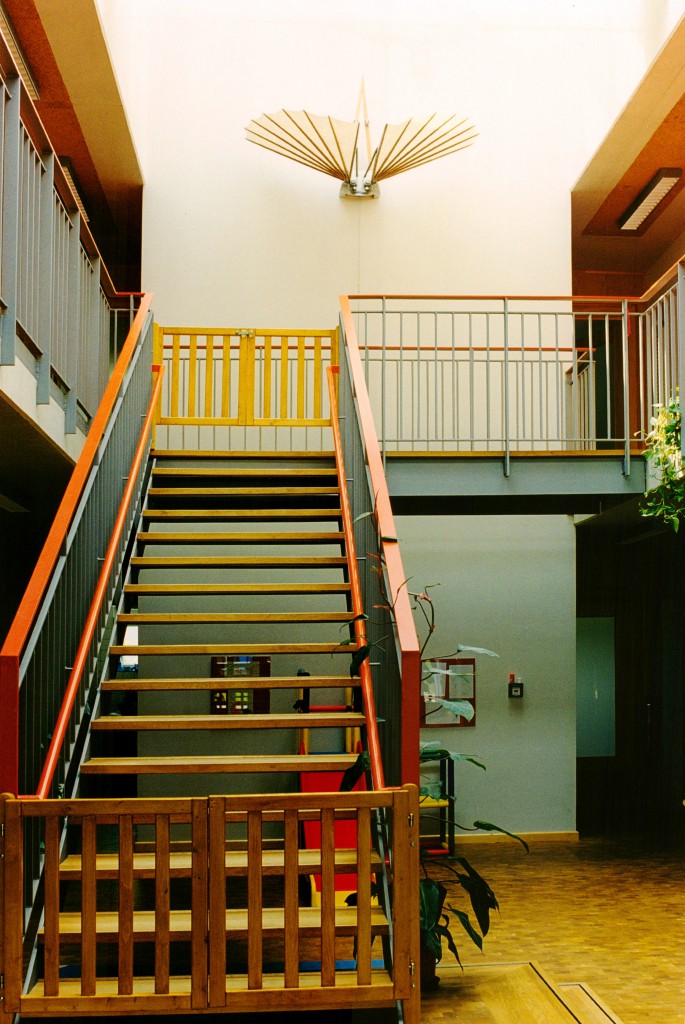 View of the stairwell, RAS 5, Britz, 1997. The children turn a crank on the ground floor and the wings move on the first floor.
Sketches and models for the SCHMETTERLING project, 1996
l